
The Numbers Don’t Lie —And the Industry is Hoping You Won’t Look

Black women represent over 11% of total beauty spend in the United States — yet Black beauty brands capture only 2.4% of revenue in the overall beauty market. That gap is not an accident. It is a system. And it is worth examining in full.

The Shelf Access That Disappeared Overnight
When DEI commitments started rolling back in early 2025, multiple Black vendors were dropped from major retailers like Target with little notice — eliminating the shelf access these brands had worked years to earn, and leaving them scrambling to survive without the distribution they had built their businesses around.
Years of relationship-building, compliance work, and operational investment — gone. With little notice. Because a commitment that was never legally enforceable was quietly rescinded.
Reporting confirmed that multiple Black vendors were allegedly dropped from Target amid the DEI rollback — illustrating how fragile shelf access remains for Black-owned brands whose distribution depends entirely on the goodwill of major retailers.
The Accelerator Illusion
For the brands that do pursue a seat at the table, the odds are staggering — and the support often falls short of what's needed to actually survive.
Sephora's Accelerate incubator program received a record-breaking 800 applications — and accepted just eight brands.
Ulta Beauty's MUSE Accelerator — the only program open exclusively to BIPOC founders — launched with a cohort of just eight indie brands. Founders who made it in quickly discovered the steep learning curve of becoming retail-ready, often without the ongoing mentorship needed to sustain long-term growth.
Eight. Out of hundreds. And even those who make it through the door face an ecosystem that was not designed to help them thrive — just to survive long enough to say they tried.
The Health Crisis Hidden in Plain Sight
Now here is what makes this even more urgent — and what most of the industry would prefer you not connect to your shopping cart.
"Women of color face higher exposures to toxic chemicals relative to white women, regardless of socioeconomic status — and Black women have higher rates of hormone-mediated conditions including more prevalent fibroids and more aggressive forms of breast and endometrial cancers."
That finding comes from researchers at the Silent Spring Institute. And it does not stand alone.
A growing body of evidence links chemicals in hair relaxers and other products marketed to Black women — including endocrine-disrupting substances like formaldehyde and phthalates — to early menstruation, reproductive health issues, and cancer.
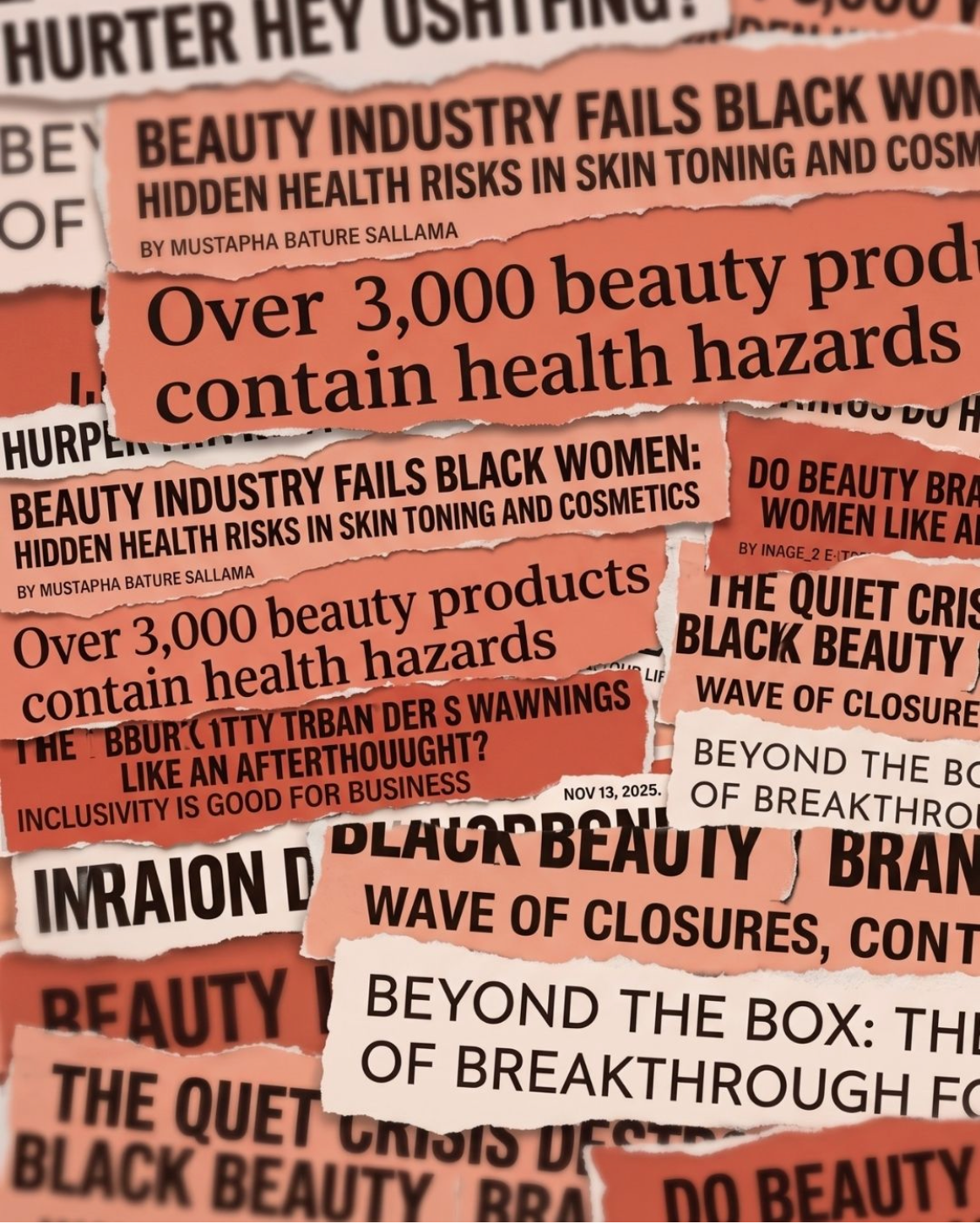
Beauty products marketed to women of color are more likely to contain hormone-disrupting chemicals linked to fibroids, infertility, and cancers. These findings were published in a peer-reviewed journal — not a blog, not a wellness influencer's opinion. The science.
These are not fringe findings. This is the published science. Products marketed to us — specifically to Black women — carry a disproportionate chemical burden. The industry knows this. And the marketing has not changed.
Why Sankofa Exists at the Intersection of All of This
The revenue gap. The rollback of shelf access. The accelerator math that says your brand probably won't make it. And the quiet accumulation of endocrine disruptors in the products marketed directly to you, in your hair and on your skin.
Sankofa Collective exists because no single one of these problems is acceptable — and addressing only one while ignoring the others is not a solution. It is a publicity strategy.
We built a platform that directs economic power toward Black-owned brands, applies pharmacist-level ingredient vetting to every product on our marketplace, and centers the health and wellbeing of Black consumers as the non-negotiable foundation of every curation decision.
Subscribe. Get on the Waitlist.
Sign up for our newsletter and be among the first to experience our soft launch exclusives — the Glow & Globe™ Travel Kit is coming.
JOIN THE WAITLIST →References
- McKinsey & Company. (2022, June). Black representation in the beauty industry. mckinsey.com
- Black Information Network. (2025, March 14). Multiple Black vendors allegedly dropped from Target amid DEI removal. binnews.com
- Sephora. (2023, December 14). Sephora announces new class of brand founders for 2024 Accelerate incubator program. newsroom.sephora.com
- Glossy. (2024, April 4). How Ulta Beauty turned an experimental accelerator program into a successful pathway for young BIPOC brands. glossy.co
- Silent Spring Institute. (n.d.). Consumer product use in women of color. silentspring.org
- Harvard T.H. Chan School of Public Health. (2024, June 15). Uncovering the dangers of hair products marketed to Black women, girls. hsph.harvard.edu
- Helm, J. S., Nishioka, M., Brody, J. G., Rudel, R. A., & Dodson, R. E. (2018). Measurement of endocrine disrupting and asthma-associated chemicals in hair products used by Black women. Environmental Research, 165, 448–458. sciencedirect.com
- NielsenIQ. (2022, June). Attracting Black beauty consumers in 2022. nielseniq.com
About the Founder
A. Elizabeth Ferguson, PharmD
Dr. A. Elizabeth Ferguson is a Doctor of Pharmacy, retired U.S. Air Force Officer, and former Federal Pharmacist with the Defense Health Agency. She served as a Health Policy Advisor to the U.S. Senate, drafting legislation for both the Committee on Health, Education, Labor, and Pensions (HELP) and the Committee on Finance. She is the Founder of Sankofa Collective™ — a pharmacist-led, curated clean beauty marketplace built exclusively for and by the Black community — and Managing Strategist at Health Strategy Collective [Global]. She currently lives in Panama City, Panama, while completing her MBA at Johns Hopkins Carey Business School with a focus in Finance and AI/ML.
Editorial Disclaimer: The views expressed in this piece are those of Dr. A. Elizabeth Ferguson and reflect her personal education, clinical training as a Doctor of Pharmacy, lived experience as a Black woman and consumer, and her convictions as a founder. This content is not intended as medical advice and does not constitute a pharmacist-patient relationship. AI tools were used to help refine and make this content editorially sound; all perspectives, positions, and conclusions are entirely her own.